The store will not work correctly when cookies are disabled.
Please be aware we use cookies to make your experience better.A cookie is a piece of data stored on a visitor's hard drive to help us improve your access and identify repeat visitors. Cookies can also enable us to track and target the interests of our users to enhance the experience on our site. Usage of a cookie is in no way linked to any personally identifiable non-public information.Learn more.
Industrial clutches connect or disconnect two shafts to transmit, interrupt, or control torque between them. The correct clutch type depends on whether engagement must be smooth or zero-backlash, whether the application requires high torque density in a compact envelope, whether torque needs to be controlled during continuous slip, and the mounting configuration — shaft-mounted for parallel shafts or flange-mounted for in-line shafts.
Electromate supplies industrial clutches from Inertia Dynamics and Ogura Clutch — two complementary lines covering general-purpose power-on electromagnetic clutches, zero-backlash tooth clutches for positive engagement, high-torque multiple-disc clutches, and magnetic particle and hysteresis clutches for tension and torque control applications.
All Inertia Dynamics clutches are UL recognized to both U.S. and Canadian safety requirements. Ogura clutches are available in electromagnetic, tooth, multiple-disc, magnetic particle, and hysteresis configurations across a torque range spanning fractional in-lbs to 1,475 ft-lbs.
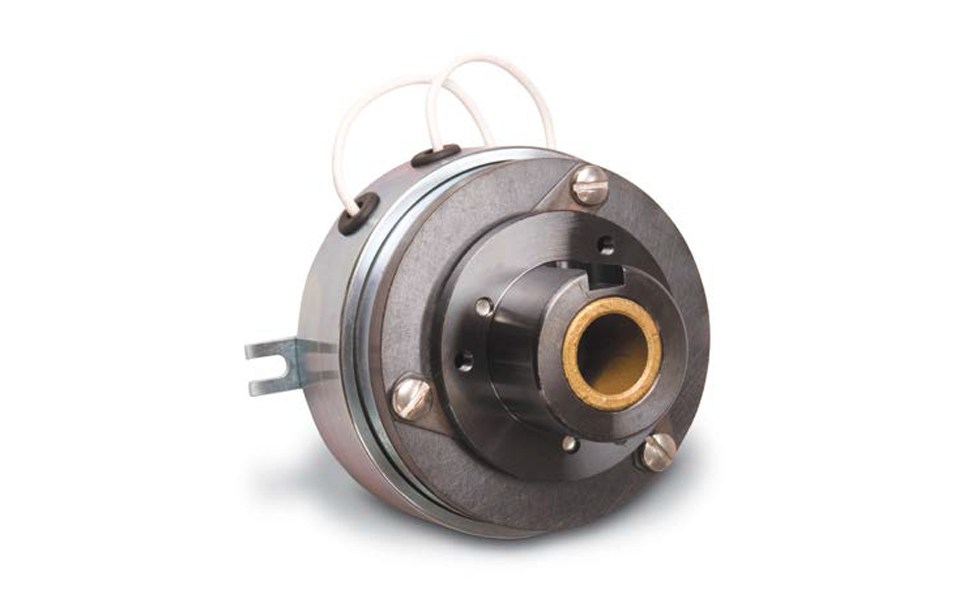
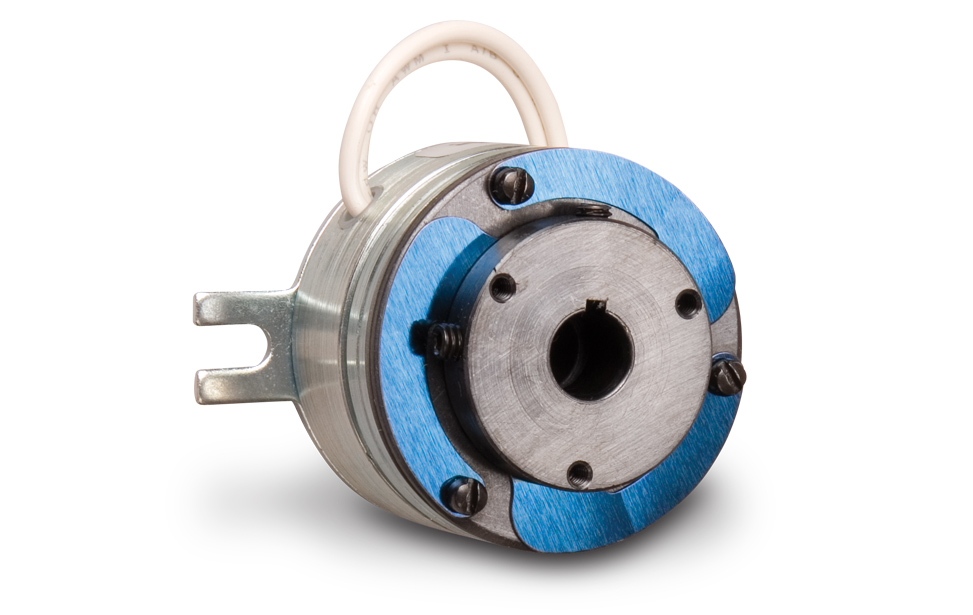
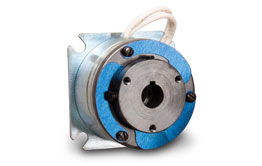
Electromagnetic clutches engage when DC voltage is applied to the coil, generating a magnetic field that pulls the armature into contact with the rotor and couples the input and output shafts. When power is removed, the clutch disengages and the shafts rotate independently. Available in shaft-mounted configurations for parallel shafts and flange-mounted configurations for in-line shafts, with clutch-coupling variants that join two in-line shafts directly. This is the general-purpose category covering the widest torque range and the largest number of available configurations.
Tooth clutches engage through interlocking teeth rather than friction surfaces, providing zero-slip, zero-backlash positive engagement. Once engaged, there is no relative motion between input and output — torque transmission is purely mechanical, not dependent on friction force. Engagement and disengagement occur only at zero or near-zero relative speed between the teeth, since engaging the teeth while shafts are at significantly different speeds will cause tooth damage. Tooth clutches are the correct choice for applications requiring precise positional synchronization between two shafts with no slip tolerance.
Multiple-disc clutches stack several friction discs to multiply torque capacity within a compact outer diameter, delivering significantly higher torque density than single-disc designs. Wet-type oil-lubricated variants provide high heat dissipation for continuous or high-cycle heavy-duty operation. These are the correct choice when high torque transmission is required but installation space is limited.
Magnetic particle clutches use a powder of magnetically susceptible particles suspended between the input and output members. When current is applied, the particles form chains that transmit torque proportionally to the applied current — independent of slip speed. This makes them suited for continuous-slip tension control applications such as winding, unwinding, and wire drawing, where the friction-based equivalent would wear quickly under constant slip.
Hysteresis clutches transmit torque through the magnetic hysteresis of a steel disc with no physical contact between input and output members. Torque is independent of slip speed and proportional to coil current, producing smooth, repeatable, wear-free torque transmission. Suited for motor and gearbox test stands, load simulation, and applications requiring consistent torque that does not change as the unit ages.
An electromagnetic clutch engages when DC voltage is applied to the coil. The resulting magnetic field pulls the armature into contact with the rotor, coupling the input and output shafts so torque transmits between them. When power is removed, the clutch disengages and the shafts rotate independently. This is the standard engagement principle for general-purpose industrial clutches.
What is the difference between an electromagnetic clutch and a tooth clutch?
An electromagnetic clutch engages through friction contact between an armature and rotor. A tooth clutch engages through interlocking mechanical teeth, providing zero-slip, zero-backlash positive engagement with no dependency on friction force. Tooth clutches must engage at zero or near-zero relative speed to avoid tooth damage, while electromagnetic clutches are designed to bring shafts into sync during engagement.
What is a multiple-disc clutch used for?
A multiple-disc clutch stacks several friction discs to multiply torque capacity within a compact outer diameter, delivering higher torque density than a single-disc design of the same size. Wet-type oil-lubricated versions add heat dissipation for continuous or high-cycle operation. They are used where high torque transmission is required but available installation space is limited.
What is the difference between a magnetic particle clutch and an electromagnetic clutch?
An electromagnetic clutch is designed to engage and stop slip between two shafts. A magnetic particle clutch is designed to operate in continuous slip while transmitting a controlled, adjustable torque that is proportional to applied current and independent of slip speed. Magnetic particle clutches are used for tension control applications such as winding and unwinding, where continuous slip would wear out a friction-based clutch.
What is a hysteresis clutch?
A hysteresis clutch transmits torque through the magnetic hysteresis of a steel disc with no physical contact between the input and output members. Torque is proportional to coil current and independent of slip speed, producing smooth, repeatable torque transmission with no friction wear. Hysteresis clutches are used in motor test stands and load simulation applications requiring consistent torque over the full service life of the unit.
Are Inertia Dynamics clutches UL recognized?
Yes. All standard Inertia Dynamics electromagnetic clutches are UL recognized to both U.S. and Canadian safety requirements.
A cookie is a piece of data stored on a visitor's hard drive to help us improve your access and identify repeat visitors. We use necessary cookies to make our site work. We'd also like to set optional cookies to help us improve it. Usage of a cookie is in no way linked to any personally identifiable non-public information. Learn More.
By clicking “Accept”, you consent to the use of ALL the cookies. However you may visit Cookie Settings to provide a controlled consent.