Please be aware we use cookies to make your experience better. A cookie is a piece of data stored on a visitor's hard drive to help us improve your access and identify repeat visitors. Cookies can also enable us to track and target the interests of our users to enhance the experience on our site. Usage of a cookie is in no way linked to any personally identifiable non-public information. Learn more.

Technical Support
 Posted: April 03, 2016
There are many challenges when designing a motion control system. One challenge that can overwhelm many engineers is nonlinear mechanics. These mechanics can make tuning a motion control system difficult. At Galil, we pride ourselves in being able to provide intuitive solutions for these nonlinear or unorthodox mechanics. This webinar will discuss six examples of applications with nonlinear mechanics, their inherent challenges, and the tools/solutions to address these challenges.
Below are the six examples of applications with nonlinear mechanics:- High-friction axis
- Mechanics with backlash
- Servo axis involving a spring
- Axis exposed to large and unpredictable outside forces
- Mechanics where inertia varies with position
- Hydraulic axis
...Robin Riley - Posted: March 31, 2016
A clutch is a mechanical device that engages and disengages a power transmission, especially from a driving shaft to a driven shaft. Clutches are used whenever the transmission of power or motion must be controlled over a time element (ie. electric screwdrivers limit how much torque is transmitted through use of a clutch).
Categories: Technical Support - Posted: March 21, 2016
A common way to generate precise linear motion is to use an electric motor (rotary motion) and pair it with a lead screw to generate a linear actuation system. Depending upon what this linear actuator interfaces with it can be constructed in a number of different ways. Here we will discuss several different ways to combine a lead screw and nut with a stepper motor to create a linear actuator system…
Click on the link below to download this complete White Paper.
LEAD SCREW LINEAR ACTUATORS: When to Apply External, Non-Captive and Captive Step Motor Actuators...
Categories: Technical Support - Posted: March 16, 2016
Servomotors are generally used as a high performance alternative to the stepper motor. Stepper motors have some inherent ability to control position, as they have built-in output steps.
This often allows them to be used as an open-loop position control, without any feedback encoder, as their drive signal specifies the number of steps of movement to rotate. This lack of feedback though limits their performance, as the stepper motor can only drive a load that is well within its capacity, otherwise missed steps under load may lead to positioning errors.
The encoder and controller of a servomotor are an additional cost, but they optimize the performance of the overall system (for all of speed, power and accuracy) relative to the capacity of the basic motor. With larger systems, where a powerful motor represents an increasing proportion of the system cost, servomotors have the advantage….
Click here to learn...
Categories: Technical Support - Posted: March 06, 2016
Power Off Brakes, sometimes referred to as Safety Brakes, Spring Set Brakes or Fail Safe Brakes, are widely used in the industry, usually on the back of motors, to hold a machine, pulley, Z axis, or robotic arm in position in case of a power failure...
 Posted: February 28, 2016
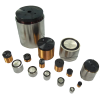
A “voice coil” is a generalized term that refers to any galvanometer-like mechanism that uses a solenoid to move an object back-and-forth within a magnetic field. In particular, it is commonly used to refer to the coil of wire that moves the read–write heads in a moving-head disk drive. In this application, a very lightweight coil of wires is mounted within a strong magnetic field produced by permanent rare-earth magnets. ...
Categories: Technical Support- Posted: February 11, 2016
Reprint of Danielle Collins post, Linear Motion Tips, on Friday, December 11, 2015
As an integral part of industrial machines and processes, ball screw assemblies often operate in environments with elevated temperatures. Heat can be generated by other mechanical and electrical components in the machine, and in some cases, is a byproduct of the process itself. And, like other motion products with sliding or rolling friction, ball screws generate heat of their own as they run. This heat, and especially the change in temperature that occurs...
Categories: Technical Support - Posted: February 04, 2016
Reprint of December 30, 2015 Linear Motion Tips article from Design World
Servo motor sizing is often done with the help of a manufacturer’s sizing program, but it’s important to understand the three most critical factors—speed, torque, and inertia—to ensure you select the best-fit motor for the application.
Selecting the right servo motor for a linear motion system is a complex task, beginning with initial assumptions and component selections, which must be checked through a series of calculations and, in most cases, repeated over several iterations until a suitable combination of motor and mechanics is found...Categories: Technical Support - Posted: November 23, 2015
New 4 minute YouTube Video
Can my step motor get hot enough to cook an egg? In this segment of The Why? Series, Bob White, Manager, Training and Digital Marketing at Kollmorgen, explains why a typical step motor may get hot. Learn why a step motor will heat up, and what can be done to reduce this heating…unless of course, you are looking to cook an egg!
Click on the link below to view this 4 minute YouTube Video.
Tags: Step Motor, Stepper Motor, Kollmorgen, Electromate
- Posted: November 19, 2015
YouTube 39min Webinar
For year’s controls and systems engineers have had to balance the robustness of magnetic encoders with the performance of optical encoders. However, this is no longer the case due to recent advances in magnetic sensing technologies. Breakthroughs in microprocessing and signal filtering have resulted in new magnetic encoders that can rival the performance of optical sensors while being more robust and compact. Learn how to select an encoder for a given application and what the future holds.\
Presented by: Jarrod Orszulak
Product Manager, POSITAL-FRABA Inc
Click Here to watch a recording of this webinar. Previously recorded webinars and product videos can also be viewed on our YouTube...
Recent Posts